Thursday, June 20, 2013

Dyeing Fibers and Fabrics with Plants


Dyeing Fibers and Fabrics with Plants

Beautiful, natural dyes are all around us. Just take a walk in your back yard or local park and you’ll find lots of plants which you can use to safely dye fabrics and fibers.

A simple google search will give you a number of lists of familiar plants you can use for dyeing such as: Avocado pit, Bloodroot, Black Eyed Susan, California Poppy, Coreopsis, Calendula, Dahlia, Dandelion, Goldenrod, Heather, Hollyhock, Indigo, Lavender, Marigold, Purple Basil, Russian Sage, Safflower, Sunflower, Tansy, Walnut, Weld, Yarrow and Zinnia to name a few. Roots, seeds, flower, leaves, and/or stems are used depending on the plant.

The same plants can yield different colors depending on the type of material being dyed (whether the material is a cellulose fiber like cotton, or a protein fiber like wool), and the type of mordant used to prepare the material. A mordant is an inorganic substance, generally an oxide, that combines with a dye to fix it to the fabric or fiber. This is a pot of wool being mordanted with alum in my dye station in the back yard.

Why dye with natural dyes? The colors are more alive. They glow in ways that pictures cannot do justice. They have beautiful natural variations and are not flat but multidimensional. Dyeing with natural dyes is a great way to get back in touch with nature and for me, it feels wonderful doing something with so much deep history. I especially like when I can use plants native to my area.

The plants I have learned to use for dyeing are: Lavender, Geranium, Calendula, Madder, Weld, Alkanet and Indigo. The first three I get from my own garden and that list is expanding every time I dye. The other plants I purchase in powdered or root form. I am currently planning a dyer’s garden which will include Weld, Japanese Indigo, Coreopsis and Dahlia.

Plants do not always yield the color you might expect and ironically, green is the hardest color to get from plants.

As a dye, Lavender gives a light yellow to tan color. I cut lavender from my garden and snip it into pieces into the dye pot and put the fiber right in with the dye stuffs. I leave the fiber in the pot overnight with the dye stuffs to get as much color in the fiber as possible.
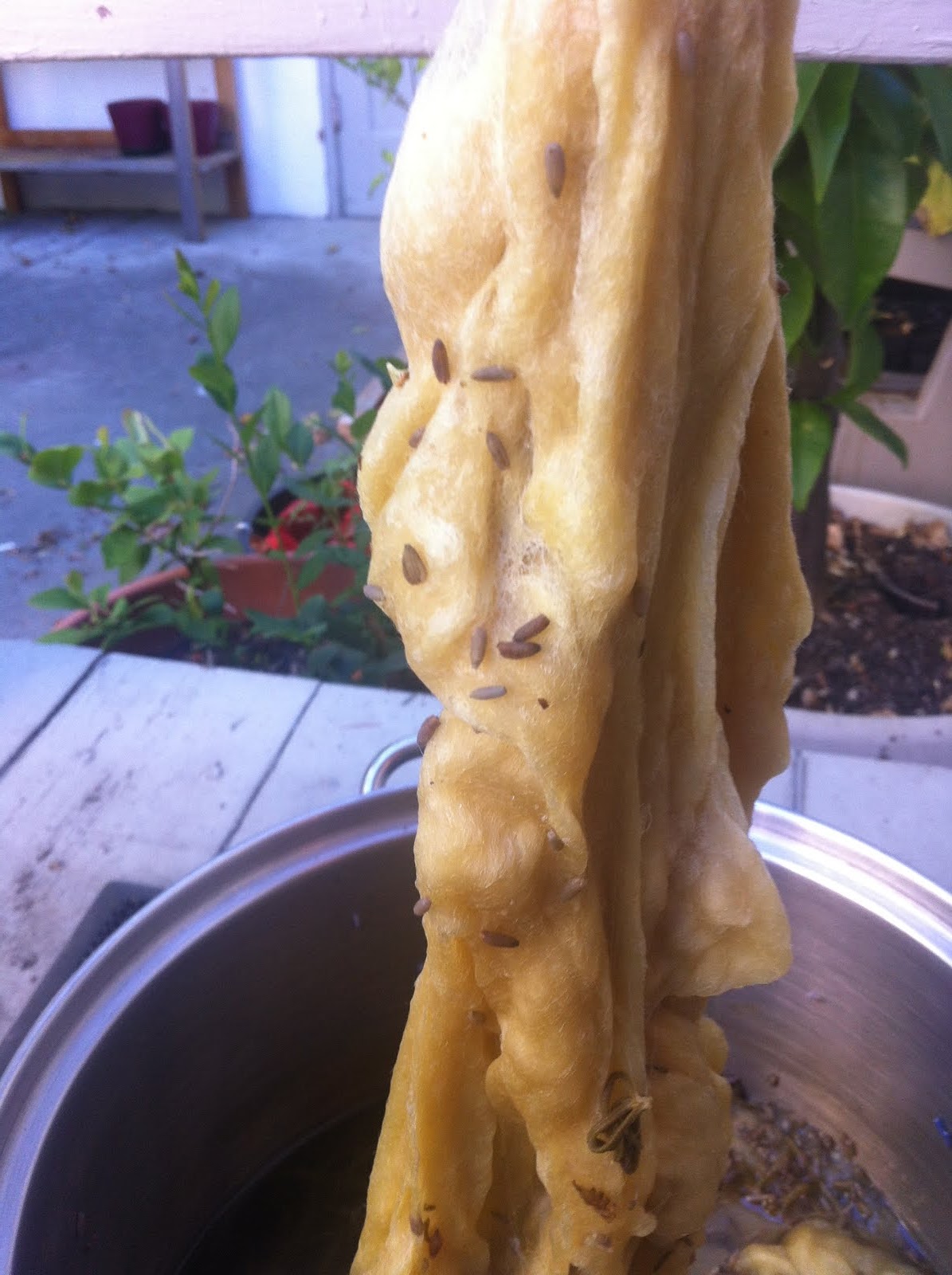

It dries a little bit lighter as with all plant dyes.

Calendula and Weld both yield a bright sunny yellow with an alum mordant.  I have also top dyed this beautiful color with indigo to get a fabulous yarn with greens, blues, and purples.
Madder and Geranium have given me very pretty reds and pink and orange hues.


Alkanet, a plant related to Borage, yields beautiful purples as you can see here.

Indigo dyeing can be a trying chemical process but I’ve discovered instant indigo crystals which are super easy to use and make dyeing with indigo fun. I’ve had success dyeing directly onto mordanted fibers and top dyeing, dipping pre-dyed fibers into the vat for a blend of color as shown in the multi-colored yarn previously.

To learn more about plant based dyes there are some fabulous resources out there. Check out Wild Color by Jenny Dean, Harvesting Color by Rebecca Burgess, The Handbook of Natural Plant Dyes by Sasha Duerr and A Weaver’s Garden by Rita Buchanan to name just a few.

I’d like to thank Sue so very much for allowing me to be here today! Come visit me on Facebook, www.facebook.com/TheMerrySpinster and at my shop www.etsy.com/shop/TheMerrySpinster. I’m also on Pinterest, http://pinterest.com/hlmarano/boards/


Wednesday, June 12, 2013

Creating a Dyer's Garden

Now that my raised beds are a bit too shaded for tomatoes and peppers each summer I'm seriously considering converting them to a dyer's garden. There is still plenty of sun to support the plants I'm aiming to put there.

Here's a list of great plants for natural dyeing of fibers and fabrics:

Marigold, Calendula officinalis, is a well known garden plant which not only acts as a great companion for tomatoes and peppers, but gives beautiful yellow gold colors to fibers and fabrics. Alum mordanted fibers will be lighter and iron mordanted ones will be darker. The flowers and the leaves can be used but the strongest colors will come from the flowers.

Chamomile, Turmeric, Weld and Yarrow will also deliver pretty light to bright yellows to fibers and fabrics.

Bloodroot, Carrot, Orange Dahlia flowers, Onion skins and paprika will yield shades of orange depending on the mordants used.

Amaranth, raspberry, rose, fig leaves, avocado pit, and lavender flowers can give pinks to corals to peach colors.

Rosemary, sage, walnut (wear gloves) can all produce browns. You can also get browns from overheating certain other plants like marigold and weld.

Woad and Indigo can give you blues and purples. These are  my favorites!

I get my greens from top dyeing with indigo over yellow.

So late this summer, when I'm contemplating spring planting and fall cover crops, I'm going to consider a handful of these plants. I already have lavender, rose, rosemary, raspberry, chamomile and yarrow growing. But I'm very interested in getting hold of madder, weld, woad and indigo.


Thursday, May 30, 2013

Chocolate Coconut Haystacks

This is Day Three of my Five Day Detox with my coach, Brien Shamp.  I find it amazing this incredibly yummy recipe is actually legal during this detox. I just made them and I'm in HEAVEN.

Chocolate Coconut Haystacks


1/2 cup Coconut Oil melted
1/2 cup raw cocoa powder (UNSWEETENED)
1/3-1/2 cup agave nectar (honestly these are so good you don't need this)
1 tsp. vanilla extract
2 cups shredded unsweetened coconut
1 cup of ground flaxseeds
2 tbsp. of sunflower butter
dash of cayenne pepper

Mix everything together in a bowl and shape into balls. Place on a tray lined with parchment or waxed paper and pop in the fridge to harden. They will last 6-12 months in the freezer. You can add or reduce ingredients as you like or need. Try adding goji berries or cacao nibs. Try it with almond butter or cacao with chili pepper.

ENJOY!


Wednesday, May 29, 2013

Detox and Rest

I've been steadily changing my diet since January. I did the Whole Living three week detox and LOVED it. The food was great and I lost nearly 12 pounds! But of course, my lousy eating habits returned and I let things go, eating too many carbs and too much sugar for my personal needs.

Then three weeks ago I started going to boot camp four mornings a week at 6 am. I am seeing results in terms of toned arms and some lessening in inches but the scale still has not moved.

So yesterday I began a five day detox with my coach. It's a protein and veggie based detox really just designed to eliminate foods for a while that are known to cause inflammation.

No sugar, no grains of any kind and the only fruit allowed, apples and pears.

So far so good. I'm most of the way through day two. I was really hungry yesterday but today less so.

I was a little worried about still having enough energy for boot camp and that's been no problem so far, and I guess that's no surprise with all the protein I'm getting.

I've been thinking about what comes next, after day five. I think I'd like to keep everything the same (it's how I feel best honestly) but add back in banana and other fruits. I miss my banana in my morning protein shake.

Speaking of shakes and smoothies, check out this great article at All Things G & D for a great recipe and idea for green smoothies. I'm going to try it once I can have bananas again!

A friend asked if I could publish a meal I made the other night which is so easy and yummy.

So here it is.

Coconut Chicken and Veggies

1 cup cooked chicken (I use either chicken I shred from a rotisserie chicken or I quickly cook up a frozen chicken breast)
1 -2 tbsp coconut oil
1 cup asparagus chopped
1 cup sliced crimini mushrooms
1/2 c chopped red, orange and or yellow bell pepper
1/2 c sliced zucchini
salt and pepper to taste.

If you have a rotisserie chicken just shred off about a cup. If you need to cook your chicken, use 1 tbsp of coconut oil to do so in a pan over medium heat. Season with salt and pepper on both sides.

Once chicken is cooked, remove from pan and cut into bite sized pieces.

Add more coconut oil if needed to the pan then add your veggies. Salt a bit to sweat the veggies.

Stir frequently to prevent browning too much on the bottom. Towards the end of the cooking time, I like mine al dente, add the chicken back in to reheat.

Dish it up and enjoy!

I've also added 1/4 c of tomato sauce, or 1 can of canned tomatoes. You can also add crushed red pepper flakes if you like. Or change up your veggies. Or use garlic and or onion. It's all super easy to customize.

I make this for lunch sometimes as well and you can even add two or three eggs to make a scramble in the morning if you like. Just whisk the eggs in a bowl and then pour over the veggies in the pan. Cook till the eggs are done.

Have fun experimenting!

Wednesday, May 15, 2013

Stagnation Nation

Well things have gotten slow around here. Not slow in terms of all the usual crap I have to do, but slow in terms of writing, promoting the shop and creating. I have so much fiber I want to spin. I have bags of alpaca I'm working on processing. I have new product ideas for the beauty line I need to work on testing.

But there's also baseball for both kids, homework, cub scouts, PTA end of the year to do's, and of course the usual grocery shopping every two days, loads and loads of laundry, cleaning and trying avoid avoiding bills.

I am finishing week three of boot camp where I've been going four mornings a week at 6 am. I'm really enjoying it but it's not really giving me more energy yet. In fact, by 3 pm I'm wiped. I'm hoping this will change as my body settles into this new calorie burning regime.

Summer is coming and that's a really good thing. It will be a change of pace. It will break me out of this stagnation I've been in recently. There will be a few summer camps where both kids are occupied nearly all day! That will mean long stretches which I can dedicate to dyeing yarn, product testing and marketing. There will also be lots of time where the kids are completely unoccupied and I'll need to arrange a lot of play dates.

What are your summer plans? Do you find the changing of the seasons brings a fresh start for you?

I'd love to hear your thoughts.

Tuesday, May 7, 2013

Rethinking Slick Tubs

So yesterday I made three sets of bath melts. It's the first time I've made them and they only had a few ingredients:
Coco butter
Sweet Almond Oil
Shea Butter
Essential Oil
Coloring

The color was the first problem. I forgot my colors are water based. What happens when you put drops of water in a pool of oils? Pretty little globules. So I put some oil and the color in a bottle and shook hard to make an emulsion. That worked so I poured it into my molds. I made Lavender, Sandalwood Vanilla and unscented and uncolored. I sprinkled little lavender buds on top of the lavender melts.

I put them in the fridge to chill faster. They popped out all pretty except the dye had settled to the bottom of the melts.

My kids didn't care. They wanted to test the product in the tub. The bathroom smelled heavenly and the boys loved watching them melt in hot water.

But this morning I nearly cracked open my skull as I stepped into an EXTREMELY slick tub. So considering the dye issue, my current product line and the fact that I don't want someone in my house to end up in the ER because they slipped in the tub, I think I'm going to turn that recipe with some tweaks, into solid lotion bars instead. SO much safer.

Wednesday, April 24, 2013

Adventures in Fiber Processing

I'm about to embark and a crazy adventure in processing LOTS, and I mean LOTS of fiber.

My friend Santha was lucky enough to go help shear alpaca on a farm last week. In return they gave her five huge garbage bags full of fiber!


I volunteered to process it for her and she's going to give me a bunch so I'm super psyched. But WOW it's a lot of fiber. I'll be posting the process as I go along. This week I've just been turning it around while in the bag to ensure some of the moisture is released. I'll start the actually scouring this weekend probably.

I'm not yet sure where I'm going to set up these scouring stations and drying stations. I'm sure I'll sort it out.

In the meantime, I got my two sheep future samples in the mail. Both are unprocessed and will need a lot of scouring to remove the dirt and much of the lanolin. Here are some pics of the first sample from a lovely little sheep called Godiva, a sweet little Navajo Churro.


As you can see, the locks are really pretty and so far as I can tell, I'll only have to snip off the bottom ends a little. The colors are really pretty and I'll be looking forward to spinning these up if I buy more.

Here are the samples from Nestor, a cutie pie and a lovely Navajo Churro sheep.


My main problem at this point is deciding whether or not I should order actual poundage of these fibers. Not because they aren't great but because it will be quite a while before I will have time to process them. They'll probably be sitting unwashed for weeks! And I'm not sure that's such a good idea. So time to do some research. I have to let her know in a few days whether or not I want a pound of each because they go fast.

I'm happy to hear any comments or suggestions from you folks out there!